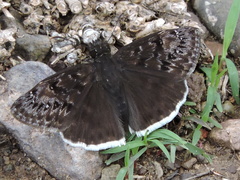
Flower visitors on Bluecrown Passionflower

4 native pollinators and other flower visitors, most recorded first.

Not native to the US

2 animals, most recorded first.

Nativity unknown

3 recorded only to genus or family, or with no nativity on record.

Western Honey Bee

on Bluecrown Passionflower

Open

Flower visitors · recorded

What the records say

  • Flowers visited by 27 records
    • iNaturalist 25 records

      iNaturalist community observations of species interactions.

    • Del Risco, A.A., Montoya, Á.M., García, V. et al. Data synthesis and dynamic visualization converge into a comprehensive biotic interaction network: a case study of the urban and rural areas of Bogotá D.C.. Urban Ecosyst (2021). https://doi.org/10.1007/s11252-021-01133-3

    • Barberis, Marta and Bitonto, Fortunato Fulvio and Costantino, Roberto and Bianco, Lorenzo and Birtele, Daniele and Bonifacino, Marco and Cangelmi, Giacomo and Capò, Miquel and Chroni, Athanasia and d’Agostino, Marco and et al. (2025). Insect-flower interactions in the Mediterranean area: a Citizen Science dataset collated within the LIFE 4 Pollinators project.

    Read by a rule · 17 records

    Bees gather pollen and nectar, so a host record is a visit to the flowers.

    References

    • García, V. (2018) Determinado por García, V. (2018) Determinado por Morales, G.
    • @article{Barberis_Bitonto_Costantino_Bianco_Birtele_Bonifacino_Cangelmi_Capò_Chroni_d’Agostino_et al._2025, title={Insect-flower interactions in the Mediterranean area: a Citizen Science dataset collated within the LIFE 4 Pollinators project}, volume={39}, url={https://www.pollinationecology.org/index.php/jpe/article/view/872}, DOI={10.26786/1920-7603(2025)872}, abstractNote={&amp;lt;p&amp;gt;Pollinators play a vital role in most terrestrial ecosystems, supporting wild plant communities and enhancing agricultural yields. However, despite their ecological and economic importance, they have been experiencing an alarming decline over the past decades. The Mediterranean region, known for harboring highly diverse communities of plants and pollinators, is particularly vulnerable due to intense anthropogenic pressures. Furthermore, the ecological roles of many floral visitors remain poorly understood, hindering conservation efforts. In response, in recent years, growing attention has been directed toward the contribution that citizens can give in support of pollinator research. An increasing number of projects have adopted a Citizen Science approach to enable large-scale data collection. The LIFE 4 Pollinators project (LIFE18/GIE/IT/000755) “Involving people to protect wild bees and other pollinators in the Mediterranean” aims to promote the conservation of pollinating insects and entomophilous plants across the Mediterranean region by fostering progressive changes in human practices that threaten wild pollinators. In addition to the implementation of several actions to raise awareness, the project launched a web platform to collect photographic records of flower–insect interaction from the public. The platform is expected to remain active for at least ten years, during which we encourage continuing record submissions by interested bodies. With this data paper we are making the current dataset freely accessible to anyone, committing to periodic online updates.&amp;lt;/p&amp;gt;}, journal={Journal of Pollination Ecology}, author={Barberis, Marta and Bitonto, Fortunato Fulvio and Costantino, Roberto and Bianco, Lorenzo and Birtele, Daniele and Bonifacino, Marco and Cangelmi, Giacomo and Capò, Miquel and Chroni, Athanasia and d’Agostino, Marco and et al.}, year={2025}, month={Nov.}, pages={306–315} }. Accessed at <https://github.com/globalbioticinteractions/life4pollinators/archive/74ddb96b7a611646153cb74d7f3fc58e2290dc52.zip> on 13 Jul 2026.
    • iNaturalist observation 88904136
    • iNaturalist observation 58473172
    • iNaturalist observation 54681242

    and 18 more

  • Interacts with 7 records