tribe
Bluestems, Lemon Grasses, Silvergrasses, and Allies
Andropogoneae
Field notes
The Andropogoneae, sometimes called the sorghum tribe, are a large tribe of grasses (family Poaceae) with roughly 1,200 species in 90 genera, mainly distributed in tropical and subtropical areas. They include such important crops as maize (corn), sugarcane, and sorghum. All species in this tribe use C4 carbon fixation, which makes them competitive under warm, high-light conditions.
Andropogoneae is classified in supertribe Andropogonodae, together with its sister group Arundinelleae. Subdivisions include 12 subtribes, but the position of several genera within them is still unresolved (incertae sedis). Hybridisation was probably important in the evolution of the Andropogoneae, and the tribe's systematics are still not completely resolved. From the morphological point of view, the merging of the former subtribe 'Dimeriinae' (having solitary spikelets borne in 'robust' raceme rachis) into the subtribe Ischaeminae (having paired spikelets borne in 'fragile' raceme rachis) is doubtful. Affinities within the tribe are complex and still under investigation. Shahid Nawaz, a grass specialist at the Blatter Herbarium, is working on the phylogenomics of the tribe from India.
According to preliminary phytogeographic research on the tribe by M.S. Kiran Raj, Peninsular India, home to 54 genera (including nine endemic genera, viz., Bhidea, Lophopogon, Glyphochloa, Pogonachne, Trilobachne, Pseudodichanthium, Triplopogon, Nanooravia, and Manisuris) and roughly 500 species, is thought to be the primary or secondary centre of diversity for Andropogonoid grasses. About 40% of the representative taxa are exclusively endemic to peninsular India, with the highest species diversity and endemicity found in genera like Arthraxon, Chrysopogon, Cymbopogon, Dichanthium, Dimeria, Heteropogon, Ischaemum, Ophiorus, Sehima, and Themeda.
Read more on WikipediaChildren
- Bluestems, Thatching Grasses, and Allies 32 native
- Anthistiriinae 8 native
- Saccharinae 5 native
- Rottboelliinae 5 native
- Johnsongrasses, Milos, Sudangrasses, Indiangrasses, and Allies 3 native
- Satintail 2 native
- Tripsacinae 2 native
- Chrysopogon 2 native
- Germainiinae 1 native
- Dimeriinae
- Apluda
- Pogonatherum
- Chionachninae
- Coicinae
- Tripidium
- Eriochrysis
- Arthraxoninae
- Spodiopogon
- Ischaeminae
Range
Greener is more native, amber more introduced; paler is less certain. How this was decided
Top native bluestems, lemon grasses, silvergrasses, and allies All
Native to the US, ranked by caterpillars, then bees and other hosts, food, flowers and shelter.
-
 Big Bluestem
Andropogon gerardi
caterpillars
14
food
10
flowers
9
shelter
1
-
 Little Bluestem
Schizachyrium scoparium
caterpillars
12
food
15
flowers
5
-
 Sand Bluestem
Andropogon hallii
caterpillars
10
food
3
-
 Seaside Bluestem
Schizachyrium littorale
caterpillars
5
-
 Creeping Little Bluestem
Schizachyrium stoloniferum
caterpillars
5
-
 Lopsided Indiangrass
Sorghastrum secundum
caterpillars
4
-
 Crimson Bluestem
Schizachyrium sanguineum
caterpillars
4
-
 Pinescrub Bluestem
Schizachyrium niveum
caterpillars
4
-
 Eastern Gamagrass
Tripsacum dactyloides
caterpillars
3
food
1
flowers
3
-
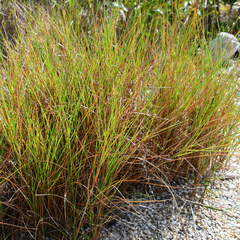 Florida Little Bluestem
Schizachyrium rhizomatum
caterpillars
3
-
 Slender Little Bluestem
Schizachyrium tenerum
caterpillars
3
-
 Indiangrass
Sorghastrum nutans
caterpillars
2
food
5
flowers
10
-
 Broomsedge Bluestem
Anatherum virginicum
caterpillars
2
food
3
flowers
1
-
 Sugarcane Plumegrass
Erianthus giganteus
caterpillars
2
food
1
-
 Slender Indiangrass
Sorghastrum elliottii
caterpillars
2