family
Grasses
Poaceae
Field notes
Poaceae ( poh-AY-see-e(y)e), also called Gramineae ( grə-MIN-ee-e(y)e), is a large and nearly ubiquitous family of monocotyledonous flowering plants commonly known as true grasses. It includes the cereal grasses, bamboos, the grasses of natural grassland and species cultivated in lawns and pasture. Poaceae is the most well-known family within the informal group known as grass.
With around 780 genera and around 12,000 species, the Poaceae is the fifth-largest plant family, following the Asteraceae, Orchidaceae, Fabaceae and Rubiaceae.
The Poaceae are the most economically important plant family, including staple foods from domesticated cereal crops such as maize, wheat, rice, oats, barley, and millet for people and as feed for meat-producing animals. They provide, through direct human consumption, a substantial portion of all dietary energy: rice provides 20%, wheat supplies 19%, and maize (corn) 5%. Some members of the Poaceae are used as building materials (bamboo, thatch, and straw); others can provide a source of biofuel, primarily via the conversion of maize to ethanol.
Grasses have stems that are hollow except at the nodes and narrow alternate leaves borne in two ranks. The lower part of each leaf encloses the stem, forming a leaf-sheath. The leaf grows from the base of the blade, an adaptation allowing it to cope with frequent grazing.
Grasslands such as savannah and prairie where grasses are dominant are estimated to constitute 40.5% of the land area of the Earth, excluding Greenland and Antarctica. Grasses are also an important part of the vegetation in many other habitats, including wetlands, forests and tundra.
Though they are commonly called "grasses", groups such as the seagrasses, rushes and sedges fall outside this family. The rushes and sedges are related to the Poaceae, being members of the order Poales, but the seagrasses are members of the order Alismatales. However, all of them belong to the monocot group of plants.
Read more on WikipediaChildren
- Pooideae 282 native
- Panicums, Bluestems, Paspalums, and Allies 236 native
- Chloridoideae 178 native
- Threeawns and Wiregrasses 27 native
- Rices, Veldtgrasses, and Allies 11 native
- Oatgrasses, Pampasgrasses, and Allies 8 native
- Bamboos, Canes, and Allies 4 native
- Micrairoideae 2 native
- Reeds, Giant Canes, and Allies 1 native
- Pharoideae
Range
Greener is more native, amber more introduced; paler is less certain. How this was decided
Top native grasses All
Native to the US, ranked by caterpillars, then bees and other hosts, food, flowers and shelter.
-
 Swamp Meadow-grass
Poa palustris
keystone
caterpillars
34
food
19
flowers
1
-
 Alpine Bluegrass
Poa alpina
keystone
caterpillars
32
food
18
flowers
1
-
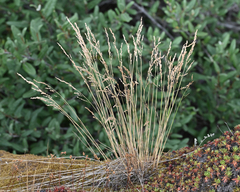 Glaucous Bluegrass
Poa glauca
keystone
caterpillars
32
food
17
flowers
1
-
 Pine Bluegrass
Poa secunda
keystone
caterpillars
30
food
7
flowers
1
-
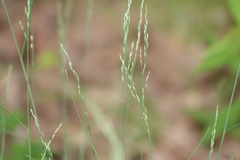 Wood Meadow-grass
Poa nemoralis
keystone
caterpillars
28
food
22
flowers
1
-
 Muttongrass
Poa fendleriana
keystone
caterpillars
28
food
6
flowers
1
-
 Inland Bluegrass
Poa interior
keystone
caterpillars
24
food
7
flowers
1
-
 Arctic Bluegrass
Poa arctica
keystone
caterpillars
21
food
6
flowers
1
-
 Marsh Bluegrass
Poa leptocoma
keystone
caterpillars
21
food
6
flowers
1
-
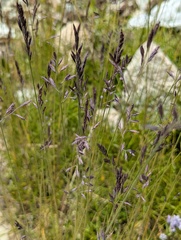 Red Fescue
Festuca rubra
keystone
caterpillars
20
food
30
shelter
1
-
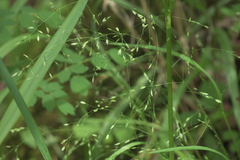 Grove Meadow Grass
Poa alsodes
keystone
caterpillars
20
food
9
flowers
1
-
 Cusick's Bluegrass
Poa cusickii
caterpillars
19
food
6
flowers
1
-
 Wheeler's Bluegrass
Poa wheeleri
keystone
caterpillars
19
food
6
flowers
1
-
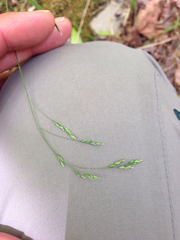 Drooping Bluegrass
Poa saltuensis
keystone
caterpillars
18
food
8
flowers
1
-
 Narrow-flower Bluegrass
Poa stenantha
keystone
caterpillars
18
food
6
flowers
1