genus
Paspalum
Paspalum
Field notes
Paspalum is a genus of plants in the grass family.
The group is widespread across much of Asia, Africa, Australia, and the Americas. Commonly known as paspalum, bahiagrasses, crowngrasses or dallis grasses, many of the species are tall perennial New World grasses. They are warm-season C4 grasses and are most diverse in subtropical and tropical regions.
Paspalum scrobiculatum (koda, varuka, varuku, etc.) is a millet locally grown as food grain. Some species, such as bahiagrass (P. notatum) and P. nicorae, are grown for pasturage, especially with the perennial forage peanut (Arachis glabrata) as a companion crop. Bahiagrass has also some significance as a honey plant.
Water finger-grass (P. vaginatum) resembles bermudagrass (Cynodon dactylon), but has a higher salinity tolerance and can consume greywater. It is not infrequently used for arena and golf course turf in warmer coastal regions, such as Baja California, Florida, Peru, Texas and Venezuela. Dedicated paspalum cultivars such as 'Aloha Seashore' or 'Platinum TE' have been produced for such uses.
Paspalums are also food for caterpillars of lepidopterans such as the pasture day moth (Apina callisto), and those of the dark palm dart (Telicota ancilla) which feed on P. urvillei. Granivorous birds often eat paspalum seeds; the chestnut-breasted munia (Lonchura castaneothorax) readily feeds on the seeds of P. longifolium, for example.
The ergot Claviceps paspali is a sac fungus that grows on Paspalum, producing ergot alkaloids and the tremorgen paspalitrem; it causes "paspalum staggers" poisoning in cattle.
Tussock paspalum (P. quadrifarium) is considered a noxious weed in Australia. The term “paspalum” without qualification in Australia refers to the common lawn weed P. dilatatum. Australia has five native and approximately sixteen naturalised species.
Daikin Park, the home ballpark of the Houston Astros, has Platinum TE Paspalum as its field surface.
Read more on WikipediaChildren 24 of 73
- Dallis Grass introduced
- Vasey Grass introduced
- Bahia Grass introduced
- Thin Paspalum native
- Hilograss native
- Knot Grass native
- Four-rowed Bead Grass native
- Florida Paspalum native
- Seashore Paspalum native
- Rustyseed Paspalum native
- Brownseed Paspalum native
- Russell River Grass present
- Field Paspalum native
- Water Paspalum native
- Ditch Millet native
- Broad-leaved Paspalum present
- Tussock Paspalum present
- Early Paspalum native
- Longtom native
- Panama Crowngrass present
- Japanese Paspalum
- Gulfdune Paspalum native
- Pitchfork Paspalum native
- Sword Grass
Range
Greener is more native, amber more introduced; paler is less certain. How this was decided
Key traits
- Layer
- Grasses and sedges
- Plant type
- Annual Ornamental grasses and sedges Perennial
From USDA PLANTS.
Top native paspalum All
Native to the US, ranked by caterpillars, then bees and other hosts, food, flowers and shelter.
-
 Hilograss
Paspalum conjugatum
caterpillars
10
food
9
flowers
1
-
 Knot Grass
Paspalum distichum
caterpillars
9
hosts
1
food
11
flowers
1
-
 Thin Paspalum
Paspalum setaceum
caterpillars
9
food
12
flowers
1
-
 Four-rowed Bead Grass
Paspalum pubiflorum
caterpillars
8
food
10
flowers
1
-
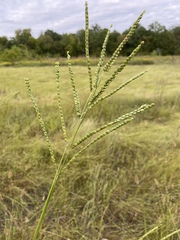 Florida Paspalum
Paspalum floridanum
caterpillars
8
food
10
flowers
1
-
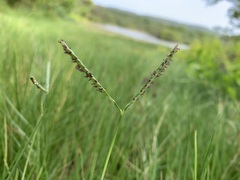 Seashore Paspalum
Paspalum vaginatum
caterpillars
8
food
10
flowers
1
-
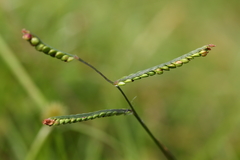 Field Paspalum
Paspalum laeve
caterpillars
8
food
10
flowers
1
-
 Water Paspalum
Paspalum repens
caterpillars
8
food
10
flowers
1
-
 Early Paspalum
Paspalum praecox
caterpillars
8
food
10
flowers
1
-
 Rustyseed Paspalum
Paspalum langei
caterpillars
8
food
9
flowers
1
-
 Brownseed Paspalum
Paspalum plicatulum
caterpillars
8
food
9
flowers
1
-
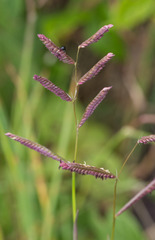 Longtom
Paspalum denticulatum
caterpillars
8
food
9
flowers
1
-
 Gulfdune Paspalum
Paspalum monostachyum
caterpillars
8
food
9
flowers
1
-
 Mudbank Crowngrass
Paspalum dissectum
caterpillars
7
food
10
flowers
1
-
 Brook Crowngrass
Paspalum acuminatum
caterpillars
7
food
10
flowers
1