species 4,150 observations
Rosilla
Helenium puberulum
Field notes
Helenium puberulum is a North American species of flowering plants in the daisy family known by the common name rosilla. It is native to California and Baja California, where it can be found in moist habitats such as riverbanks and meadows. It has also been found in Oregon, although these might possibly be naturalized populations.
Helenium puberulum is an annual or perennial herb sometimes as much as 160 cm tall though other times much smaller. Most of the leaves are on the lower part of the plant. Stems are winged, meaning that they have flaps of tissue running down the sides. One plant can produce as many as 30 flower heads in a branched array. The head is unusual in that the part covered by the disc florets is almost completely spherical rather than conical as in most other species of the genus. There can sometimes be over 1000 small disc florets in the head, each yellow at the bottom but brown or purple toward the tip. The 13-17 yellow ray florets are small and inconspicuous, pointing backwards down the flower stalk. Sometimes the ray florets are completely absent. The fruit is a hairy achene one to two millimeters long.
Read more on WikipediaSupports All
supported in the US
-
Caterpillars
Moths and butterflies raised on it
 Dainty Sulphur
1
-
Specialist bees
Bees whose young are raised on the pollen of it


 Parallel Leafcutter Bee, Curved Pebble Bee, Horn-faced Leafcutter Bee, Small Long-horned Bee
5
-
Plant eaters
Animals that feed on it

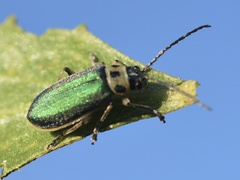
 Euodynerus annulatus, Coyote Brush Leaf Beetle, American Sand Wasp
3
-
Flower visitors
Pollinators and other flower visitors

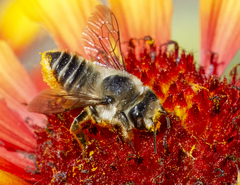

 Acmon Blue, Western Leafcutter Bee, Mylitta Crescent, Tripartite Sweat Bee
21
Range
Greener is more native, amber more introduced; paler is less certain. How this was decided
Key traits
- Layer
- Herbaceous plants
- Plant type
- Annual Perennial Wildflower
From USDA PLANTS.