genus
Mountain-laurels
Kalmia
Field notes
Kalmia is a genus of about ten species of evergreen shrubs from 0.2–5 m tall, in the family Ericaceae (heath). They are native to North America (mainly in the eastern half of the continent) and Cuba. They grow in acidic soils, with different species in wet acid bog habitats (K. angustifolia, K. polifolia) and dry, sandy soils (K. ericoides, K. latifolia).
Kalmia was named by Linnaeus to honour his friend the botanist Pehr Kalm, who collected it in eastern North America during the mid-18th century. Earlier, Mark Catesby saw it during his travels in Carolina, and after his return to England in 1726, imported seeds. He described it, a costly rarity, in his Natural History of Carolina, as Chamaedaphne foliis tini, that is to say "with leaves like the Laurustinus"; the botanist and plant-collector Peter Collinson, who had begged some of the shrub from his correspondent John Custis in Virginia, wrote, when his plants flowered, that "I Really Think it exceeds the Laurus Tinus."
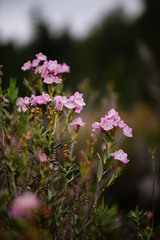
The leaves are 2–12 cm long and simple lanceolate. The flowers are white, pink or purple, in corymbs of 10–50, reminiscent of Rhododendron flowers but flatter, with a star-like calyx of five conjoined petals; each flower is 1–3 cm diameter. The fruit is a five-lobed capsule, which splits to release the numerous small seeds.
The foliage contains grayanotoxins, a group of closely related neurotoxins named after Leucothoe grayana, native to Japan, so it is toxic if eaten, with sheep being particularly prone to poisoning, hence the name lambkill used for some of the species. Other names for Kalmia, particularly Kalmia angustifolia, are sheep-laurel, lamb-kill, calf-kill, kill-kid, and sheep-poison, which may be written with or without the hyphen. (See species list below.) "Kid" here refers to a young goat, not a human child, but the foliage and twigs are toxic to humans as well.
It has also been called spoonwood because Kalm was told by Dutch settlers of North America that Native Americans made spoons from the wood. Given its toxicity, this may be folklore rather than scientific fact.
Kalmias are popular garden shrubs, grown for their decorative flowers. They should not be planted where they are accessible to livestock due to the toxicity.
Kalmia species are used as food plants by the larvae of some lepidopteran species including Coleophora kalmiella which feeds exclusively on Kalmia.
Read more on WikipediaChildren
Range
Greener is more native, amber more introduced; paler is less certain. How this was decided
Key traits
- Layer
- Trees
From USDA PLANTS.
Top native mountain-laurels All
Native to the US, ranked by caterpillars, then bees and other hosts, food, flowers and shelter.
-
 Sheep Laurel
Kalmia angustifolia
caterpillars
28
bees
3
food
6
flowers
55
-
 Mountain Laurel
Kalmia latifolia
caterpillars
18
bees
3
food
4
flowers
39
-
 Sand Myrtle
Kalmia buxifolia
caterpillars
15
bees
3
food
3
flowers
17
-
 Swamp Laurel
Kalmia polifolia
caterpillars
15
food
5
flowers
18
-
 Carolina Wicky
Kalmia carolina
caterpillars
9
bees
1
food
3
flowers
7
-
 Sandhill Laurel
Kalmia hirsuta
caterpillars
8
food
2
flowers
4
-
 Western Bog Laurel
Kalmia microphylla
caterpillars
5
food
1
flowers
15
-
 Alpine Azalea
Kalmia procumbens
caterpillars
3
food
7
flowers
6