order
Salamanders
Caudata
Field notes
Salamanders are a group of amphibians typically characterized by their lizard-like appearance, with slender bodies, blunt snouts, short limbs projecting at right angles to the body, and the presence of a tail in both larvae and adults. All ten extant salamander families are grouped together under the order Urodela, the sole surviving order from the group Caudata. Urodela is a scientific Latin term based on the Ancient Greek οὐρά δήλη (ourà dēlē), "conspicuous tail". Caudata is the Latin for "tailed ones", from cauda, "tail".
Salamander diversity is highest in eastern North America, especially in the Appalachian Mountains; most species are found in the Holarctic realm, with some species present in the Neotropical realm. Salamanders never have more than four toes on their front legs and five on their rear legs, but some species have fewer digits and others lack hind limbs. Their permeable skin usually makes them reliant on habitats in or near water or other cool, damp places. Some salamander species are fully aquatic throughout their lives, some take to the water intermittently, and others are entirely terrestrial as adults.
This group of amphibians is capable of regenerating lost limbs as well as other damaged parts of their bodies. Researchers seek to reverse engineer the regenerative processes for potential human medical applications, such as brain and spinal cord injury treatment or preventing harmful scarring during heart surgery recovery. The salamander's ability to regenerate is not limited to limbs but extends to vital organs such as the heart, jaw, and parts of the spinal cord, contrasting most other vertebrates. This ability is special in that it occurs without any type of scarring. This has made salamanders a widespread model organism in scientific research aimed at understanding and achieving regenerative processes for medical advancements in human and animal biology.
Members of the family Salamandridae are mostly known as newts and lack the costal grooves along the sides of their bodies typical of other groups. The skin of some species contains the powerful poison tetrodotoxin; these salamanders tend to be slow-moving and have bright warning coloration to advertise their toxicity. Salamanders typically lay eggs in water and have aquatic larvae, but great variation occurs in their lifecycles. Some species in harsh environments reproduce while still in the Salamander larval state.
Read more on WikipediaChildren
Range
Greener is more native, amber more introduced; paler is less certain. How this was decided
Most observed native salamanders All
Native to the US, by observations.
-
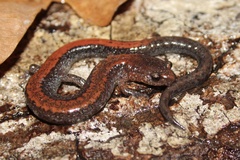 Eastern Red-backed Salamander
Plethodon cinereus
101,595 observations
-
 Eastern Newt
Notophthalmus viridescens
84,995 observations
-
 California Newt
Taricha torosa
47,445 observations
-
 Spotted Salamander
Ambystoma maculatum
43,435 observations
-
 California Slender Salamander
Batrachoseps attenuatus
29,731 observations
-
 Rough-skinned Newt
Taricha granulosa
26,310 observations
-
 Ensatina
 eschscholtzii
25,712 observations
-
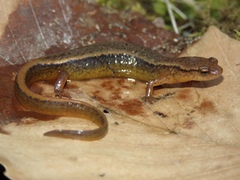 Northern Two-lined Salamander
Eurycea bislineata
18,606 observations
-
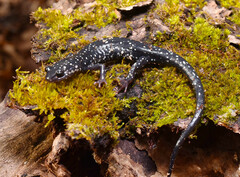 Northern Slimy Salamander
Plethodon glutinosus
16,582 observations
-
 Southern Two-lined Salamander
Eurycea cirrigera
15,366 observations
-
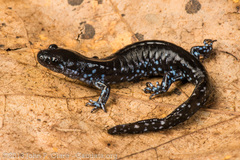 Blue-spotted Salamander
Ambystoma laterale
15,161 observations
-
 Marbled Salamander
Ambystoma opacum
12,322 observations
-
 Arboreal Salamander
Aneides lugubris
10,637 observations
-
 Northern Dusky Salamander
Desmognathus fuscus
10,350 observations
-
 Red Salamander
Pseudotriton ruber
9,349 observations