kingdom
Animals
Animalia
Field notes
Animals are multicellular, eukaryotic organisms belonging to the biological kingdom Animalia (). Animals consume organic material, breathe oxygen, have muscle cells, can reproduce sexually, and grow from a hollow sphere of cells, the blastula, during embryonic development. With few exceptions, animals are able to move. Animals form a clade, meaning that they arose from a single common ancestor. Over 1.5 million living animal species have been described, of which around 1.05 million are insects, over 85,000 are molluscs, and around 65,000 are vertebrates. It has been estimated there are as many as 7.77 million animal species on Earth. Animal body lengths range from 8.5 μm (0.00033 in) to 33.6 m (110 ft). They have complex ecologies and interactions with each other and their environments, forming intricate food webs. The scientific study of animals is known as zoology, and the study of animal behaviour is known as ethology.
The animal kingdom is divided into five major clades, namely Porifera, Ctenophora, Placozoa, Cnidaria and Bilateria. Most living animal species belong to the clade Bilateria, a highly proliferative clade whose members have a bilaterally symmetric and significantly cephalised body plan, and the vast majority of bilaterians belong to two large clades: the protostomes, which include organisms such as arthropods, molluscs, flatworms, annelids and nematodes; and the deuterostomes, which include echinoderms, hemichordates and chordates, the last of which contains the vertebrates. The much smaller basal phylum Xenacoelomorpha have an uncertain position within Bilateria.
Animals are first represented in the fossil record in the Ediacaran period, with most modern animal phyla appearing as marine species in the Cambrian explosion, which began around 539 million years ago (Mya), and most classes during the Ordovician radiation 485.4 Mya. Common to all living animals, 6,331 groups of genes have been identified that may have arisen from a single common ancestor that lived about 650 Mya during the Cryogenian period.
Historically, Aristotle divided animals into those with blood and those without. Carl Linnaeus created the first hierarchical biological classification for animals in 1758 with his Systema Naturae, which Jean-Baptiste Lamarck expanded into 14 phyla by 1809. In 1874, Ernst Haeckel divided the animal kingdom into the multicellular Metazoa (now synonymous with Animalia) and the Protozoa, single-celled organisms no longer considered animals. In modern times, the biological classification of animals relies on advanced techniques, such as molecular phylogenetics, which are effective at demonstrating the evolutionary relationships between taxa.
Humans make use of many other animal species for food (including meat, eggs, and dairy products), for materials (such as leather, fur, and wool), as pets and as working animals for transportation, and services. Dogs, the first domesticated animal, have been used in hunting, in security and in warfare, as have horses, pigeons and birds of prey; while other terrestrial and aquatic animals are hunted for sports, trophies or profits. Non-human animals are also an important element of human culture, having appeared in cave arts and totems since the earliest times, and are frequently featured in mythology, religion, arts, literature, heraldry, politics, and sports.
Read more on WikipediaChildren 24 of 30
- Arthropods 31,716 native
- Chordates 2,845 native
- Mollusks 2,203 native
- Cnidarians 333 native
- Ringed Worms 253 native
- Echinoderms 195 native
- Sponges 194 native
- Rotifers 91 native
- Bryozoans 74 native
- Flatworms 65 native
- Ribbon Worms 27 native
- Comb Jellies 22 native
- Nematodes 13 native
- Brachiopods 7 native
- Hemichordates 3 native
- Horseshoe Worms 3 native
- Entoprocts 3 native
- Tardigrades 2 native
- Gastrotrichs 2 native
- Horsehair Worms 2 native
- Xenoturbellids and Allies 2 native
- Priapulid Worms 1 native
- Thorny-headed Worms 1 native
- Cycliophorans 1 native
Range
Greener is more native, amber more introduced; paler is less certain. How this was decided
Most observed native animals All
Native to the US, by observations.
-
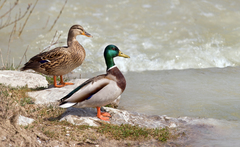 Mallard
Anas platyrhynchos
954,115 observations
-
 Monarch
Danaus plexippus
533,578 observations
-
 Canada Goose
Branta canadensis
482,447 observations
-
 American Robin
Turdus migratorius
468,520 observations
-
 Great Blue Heron
Ardea herodias
458,329 observations
-
 Great Egret
Ardea alba
419,979 observations
-
 White-tailed Deer
Odocoileus virginianus
418,929 observations
-
 Eastern Gray Squirrel
Sciurus carolinensis
402,133 observations
-
 Northern Cardinal
Cardinalis cardinalis
386,519 observations
-
 Red-tailed Hawk
Buteo jamaicensis
356,845 observations
-
 House Finch
Haemorhous mexicanus
341,737 observations
-
 Red-winged Blackbird
Agelaius phoeniceus
314,578 observations
-
 Common Eastern Bumble Bee
Bombus impatiens
314,135 observations
-
 Mourning Dove
Zenaida macroura
307,598 observations
-
 Red Admiral
Vanessa atalanta
291,090 observations