species 7,335 observations
He-huckleberry
Lyonia ligustrina
Field notes
Lyonia ligustrina is a species of flowering plant in the family Ericaceae known by the common names maleberry and he-huckleberry. It is native to the eastern United States from Maine to Florida and west to Texas and Oklahoma.
This shrub grows up to 4 m (13 ft) tall. It has long rhizomes which may send up new stems up to 4 m (13 ft) apart. The stems have longitudinally furrowed bark. The leaves may be deciduous or not, depending on variety. They are oval in shape and up to 10.5 cm (4.1 in) long by 5 cm (2.0 in) wide. The small flowers are white. The fruit is a small, dry capsule.
This is a common plant in several types of habitat, including savanna, bog, forest, pocosin, and swamp. It often occurs in ecotones. It can grow in wet and dry habitat types. It is tolerant of fire, budding and sending up shoots from its rhizome if aboveground parts are burned away. It grows in fire-prone habitat types, such as pine barrens.
The plant gets its common names from the fact that it produces hard, dry capsules instead of fleshy, juicy, edible fruits like other Ericaceae species such as huckleberries and blueberries.
Read more on WikipediaSupports All
supported in the US
-
Caterpillars
Moths and butterflies raised on it


 Apple Sphinx, Azalea Caterpillar Moth, Chain-dotted Geometer, Huckleberry Sphinx
7
-
Specialist bees
Bees whose young are raised on the pollen of it


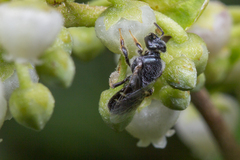 Melitta melittoides, Kalmia Miner Bee, Colletes productus, Perdita novaeangliae
4
-
Flower visitors
Pollinators and other flower visitors
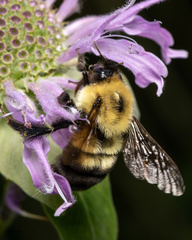


 Two-spotted Bumble Bee, Perplexing Bumble Bee, Edwards' Hairstreak, Common Eastern Bumble Bee
15
Children
Range
Greener is more native, amber more introduced; paler is less certain. How this was decided
Key traits
- Layer
- Shrubs
- Light
- Part shade
- Moisture
- Well drained Wet
- Soil pH
- Acid
- Resists
- Wet soil
- Habit
- Erect Multi stemmed Spreading
From NC State Extension, USDA PLANTS and the Lady Bird Johnson Wildflower Center.