suborder
Woodlice
Oniscidea
Field notes
Woodlice are terrestrial isopods in the suborder Oniscidea. Their name is derived from being often found in old wood, and from louse, a parasitic insect, although woodlice are neither parasitic nor insects. Other common names include slater, sow bug, and wood pig, common names varying widely by region.
Woodlice are suggested to have colonised land during the late Paleozoic based on molecular clock analysis, though the oldest known fossils are from the mid-Cretaceous period around 100 million years ago.
Woodlice have many common names and although often referred to as terrestrial isopods, some species live in semiaquatic environments like those of the genus Ligia. Woodlice in the families Armadillidae, Armadillidiidae, Eubelidae, Tylidae and some other genera can roll up into a roughly spherical shape (conglobate) as a defensive mechanism or to conserve moisture; others have partial rolling ability, but most cannot conglobate at all.
Woodlice are primarily detritivorous, and are a major contributor to the humification process by breaking down litter via ingestion. By reingesting their own faeces (coprophagy) they gain more nutrients from poor-quality leaf litter and increase the rate at which plant debris are transformed in humus.
Woodlice have a basic morphology of a segmented, dorso-ventrally flattened body with seven pairs of jointed legs, and have some or all five pairs of their pleopods (swimming legs) adapted for respiration. Like other peracarids, female woodlice carry fertilised eggs in their marsupium, through which they provide developing embryos with water, oxygen and nutrients. The immature young hatch as mancae and receive further maternal care in some species. Juveniles then go through a series of moults before reaching maturity. Mancae are born with six pereon (thoracic) segments and gain an additional one after their first moult.
Key adaptations to terrestrial life have led to a highly diverse set of animals. From the marine littoral zone and subterranean lakes to arid deserts and desert slopes 4,725 m (15,500 ft) above sea-level, woodlice can be found in every continent other than Antarctica, in almost all kinds of terrestrial and coastal habitats, being absent only from polar regions and very high altitudes. Due to the permeability of their exoskeletons, woodlice are susceptible to water loss and can often be found beneath surfaces such as the underside of logs and rocks to avoid desiccation under sunlight.
Woodlice are widely studied in the contexts of evolutionary biology, behavioural ecology, and nutrient cycling. They are popular as pets often favoured because of their varied colour and texture forms, ease of care, or for the purpose of serving as a terrarium cleanup crew.
Read more on WikipediaChildren
Range
Greener is more native, amber more introduced; paler is less certain. How this was decided
Most observed native woodlice All
Native to the US, by observations.
-
 Western Sea Slater
Ligia occidentalis
6,018 observations
-
 Sleepy Seaslater
Ligia pallasii
2,633 observations
-
 Florida Fast Woodlouse
Atlantoscia floridana
985 observations
-
 Western Rockslater
Ligidium gracile
812 observations
-
 Oak Woodlouse
Porcellionides virgatus
605 observations
-
 Commando Isopod
Alloniscus perconvexus
559 observations
-
 Eastern Rockslater
Ligidium elrodii
310 observations
-
 Broad Rockslater
Ligidium latum
228 observations
-
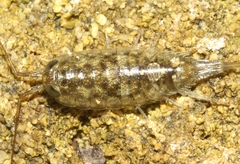 Central American Seaslater
Ligia baudiniana
185 observations
-
 Eastern Saltmarsh Woodlouse
Littorophiloscia vittata
171 observations
-
 Western Saltmarsh Woodlouse
Littorophiloscia richardsonae
166 observations
-
 Venezillo microphthalmus
148 observations
-
 Arizona Pill-Bug
Venezillo arizonicus
126 observations
-
 Brackenridgia heroldi
100 observations
-
 Wonderful Wracklouse
Alloniscus mirabilis
82 observations