genus
Hydrangeas
Hydrangea
Field notes
Hydrangea ( or ) is a genus of more than 70 species of flowering plants native to Asia and the Americas. Hydrangea is also used as the common name for the genus; some (particularly H. macrophylla) are also often called hortensia. The genus was first described from Virginia in North America, but by far the greatest species diversity is in eastern Asia, notably China, Korea, and Japan. Most are shrubs 1–3 m (3 ft 3 in – 9 ft 10 in) tall, but some are small trees, and others lianas reaching up to 30 m (100 ft) by climbing up trees. They can be either deciduous or evergreen, though the widely cultivated temperate species are all deciduous.
The flowers of many hydrangeas act as natural pH indicators, producing blue flowers when the soil is acidic and pink ones when the soil is alkaline.
Read more on WikipediaChildren
Range
Greener is more native, amber more introduced; paler is less certain. How this was decided
Key traits
- Layer
- Shrubs
From USDA PLANTS.
Top native hydrangeas All
Native to the US, ranked by caterpillars, then bees and other hosts, food, flowers and shelter.
-
 Wild Hydrangea
Hydrangea arborescens
caterpillars
4
hosts
1
food
3
flowers
151
-
 Oakleaf Hydrangea
Hydrangea quercifolia
caterpillars
4
flowers
102
-
 Woodvamp
Hydrangea barbara
caterpillars
3
flowers
85
-
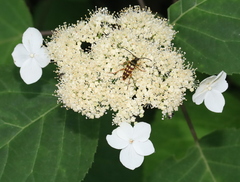 Ashy Hydrangea
Hydrangea cinerea
caterpillars
3
flowers
85
-
 Snowy Hydrangea
Hydrangea radiata
caterpillars
3
flowers
84
-
 Kanawao
Hydrangea arguta
food
1