species 2,083 observations
Coastal Mugwort
Artemisia suksdorfii
Field notes
Artemisia suksdorfii is a North American species of sagebrush in the sunflower family. It is known by the common names coastal mugwort, coastal wormwood, and Suksdorf sagewort. It is native to coastal regions from British Columbia, Washington, Oregon, and northern California as far south as Sonoma County, with isolated populations on Santa Catalina Island in Los Angeles County.
Artemisia suksdorfii grows in coastal drainages and other habitat near the ocean. This is a rhizomatous perennial herb producing many erect stems one half to two meters in height. The unbranched stems are brownish and have woody bases. The leaves are narrow and lobed, green and hairless on top and white and woolly underneath. The inflorescence is generally spike-like, up to 30 centimeters long and a few wide. It contains many clusters of small flower heads with shiny yellow-green phyllaries and yellow disc and pistillate florets. The fruit is a tiny achene less than a millimeter long.
The species is named for German-American botanist Wilhelm Nikolaus Suksdorf (1850-1932).
Read more on WikipediaSupports All
supported in the US
-
Caterpillars
Moths and butterflies raised on it


 Painted Lady, American Lady, Nutmeg Moth, Sagebrush Sheep Moth
6
-
Hosted animals
Gall makers, leaf miners and other animals living on or in it


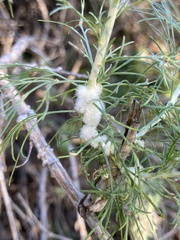 Sponge Gall Midge, Sagebrush Medusa Gall Midge, Eutreta diana, Sagebrush Woolly Stem Gall Midge
4
-
Plant eaters
Animals that feed on it


 Van Duzee's Cicada, Redpoll, Plum-thistle Aphid
3
Range
Greener is more native, amber more introduced; paler is less certain. How this was decided
Key traits
- Layer
- Herbaceous plants
- Plant type
- Perennial Wildflower
From USDA PLANTS.