species 10,469 observations
Spreading Fleabane
Erigeron divergens
Field notes
Erigeron divergens is a species of flowering plant in the family Asteraceae known by the common name spreading fleabane. It is native to western North America.
This plant is highly variable in form. It is an annual or perennial herb growing from a taproot and sometimes a caudex. It produces one to many stems 7 to 70 centimeters (3 to 27+1⁄2 inches) tall. It is a hairy plant, and the hairs are usually glandular, at least near the top of the stem. The basal leaves are 1 to 7 cm (1⁄2 to 3 in) long, and leaves higher on the stem are smaller. Flowering from April to September, the inflorescence can hold over 100 flower heads, each about 2.5 cm (1 in) wide. The heads have 75 to 150 ray florets not more than 1 cm long which are white in color, fading purple, and sometimes absent. There are many yellow disc florets at the center. The fruit is seed-like and about 1 millimeter (1⁄16 in) long with bristles on the tip.
The species exhibits agamospermy, asexual reproduction via seeds. Many, but not all, individuals are polyploid. There are many similar species both inside and outside the genus.
This plant can be found in the western half of the United States (as far east as western Texas), the Canadian provinces of British Columbia and Alberta, and the Mexican states of Baja California, Chihuahua, Durango, Nuevo León, and Sonora. It occurs in many types of habitat, including desert shrublands and scrubs, grassland, meadows, pinyon–juniper woodland, oak and pine woodlands, riparian habitat, sagebrush, and disturbed areas.
This plant had a number of uses in Native American traditional medicine. The Navajo used it as an aid in childbirth, as a lotion, an eyewash, and a treatment for snakebite and headache. It was a good luck charm among the Kiowa people.
Read more on WikipediaSupports All
supported in the US
-
Caterpillars
Moths and butterflies raised on it


 Cucullia lilacina, Common Eupithecia Moth, Wavy-lined Emerald, Parectopa plantaginisella
13
-
Specialist bees
Bees whose young are raised on the pollen of it


 Pugnacious Leafcutter Bee, Sunflower Burrowing-Resin Bee, Horn-faced Leafcutter Bee, Small Long-horned Bee
17
-
Hosted animals
Gall makers, leaf miners and other animals living on or in it

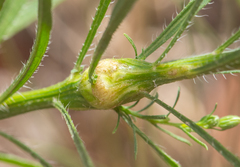

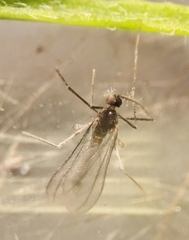 Beautiful Fleabane Root-borer, Neolasioptera erigerontis, Asteromyia modesta, Rhopalomyia erigerontis
4
-
Plant eaters
Animals that feed on it


 Northern Paper Wasp, Keeled Treehopper, Pissonotus brunneus, Large Fleabane Daisy Aphid
7
-
Flower visitors
Pollinators and other flower visitors
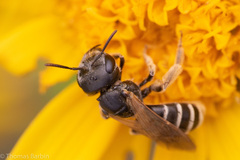


 Ligated Furrow Bee, Tiny Small Carpenter, Eastern Masked Bee, Epaulette Metallic Sweat Bee
193
Range
Greener is more native, amber more introduced; paler is less certain. How this was decided
Key traits
- Layer
- Herbaceous plants
- Light
- Part shade
- Moisture
- Moist
- Plant type
- Wildflower
From USDA PLANTS and the Lady Bird Johnson Wildflower Center.