family
Water Striders
Gerridae
Field notes
The Gerridae are a family of insects in the order Hemiptera, commonly known as water striders, water skeeters, water scooters, water bugs, pond skaters, water skippers, water gliders, water skimmers or puddle flies. They are true bugs of the suborder Heteroptera and have mouthparts evolved for piercing and sucking. A distinguishing feature is the ability to move on top of the water's surface, making them pleuston (surface-living) animals. They can be found on most ponds, rivers or lakes, and over 1,700 species of gerrids have been described, 10% of them being marine.
While 90% of gerrids are freshwater bugs, the oceanic Halobates makes the family quite exceptional among insects. The genus Halobates was first heavily studied between 1822 and 1883 when Francis Buchanan White collected several different species during the Challenger expedition. Around this time, Eschscholtz discovered three species of the Gerridae, bringing attention to the species, though little of their biology was known. Since then, the Gerridae have been continuously studied due to their ability to walk on water and unique social characteristics.
Read more on WikipediaChildren
Range
Greener is more native, amber more introduced; paler is less certain. How this was decided
Most observed native water striders All
Native to the US, by observations.
-
 North American Common Water Strider
Aquarius remigis
20,610 observations
-
 Neogerris hesione
1,626 observations
-
 Limnoporus canaliculatus
1,174 observations
-
 Trepobates subnitidus
1,055 observations
-
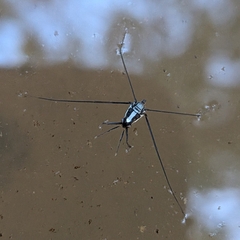 Metrobates hesperius
692 observations
-
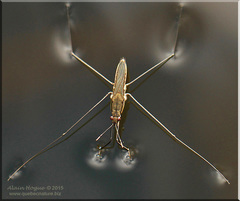 Aquarius conformis
339 observations
-
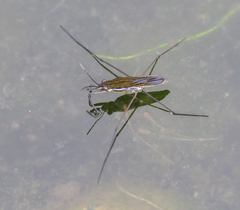 Gerris buenoi
68 observations
-
 Aquarius nebularis
48 observations
-
 Trepobates inermis
38 observations
-
 Rheumatobates rileyi
36 observations
-
 Aquarius amplus
19 observations
-
 Silvery Sea Skater
Halobates sericeus
15 observations
-
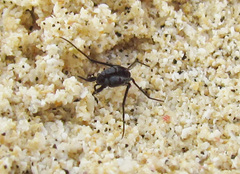 Hawaiian Sea Skater
Halobates hawaiiensis
10 observations
-
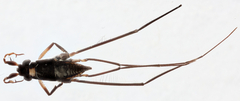 Rheumatobates tenuipes
8 observations
-
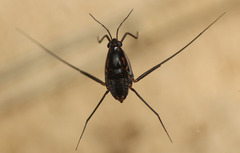 Trepobates floridensis
5 observations