family
Wireworms
Elateridae
Field notes
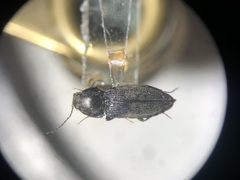
Elateridae or click beetles (or "typical click beetles" to distinguish them from the related families Cerophytidae and Eucnemidae, which are also capable of clicking) are a family of beetles. Other names include elaters, snapping beetles, spring beetles or skipjacks. This family was defined by English zoologist William Elford Leach (1790–1836) in 1815. They are a cosmopolitan beetle family characterized by the unusual click mechanism they possess. There are a few other families of Elateroidea in which a few members have the same mechanism, but most elaterid subfamilies can click. A spine on the prosternum can be snapped into a corresponding notch on the mesosternum, producing a violent "click" that can bounce the beetle into the air. The evolutionary purpose of this click is debated: hypotheses include that the clicking noise deters predators or is used for communication, or that the click may allow the beetle to "pop" out of the substrate in which it is pupating. It is unlikely that the click is used for avoiding predators as it does not carry the beetle very far (<50 cm), and in practice click beetles usually play dead or flee normally. There are about 9300 known species worldwide, and 965 valid species in North America.
Read more on WikipediaChildren
Range
Greener is more native, amber more introduced; paler is less certain. How this was decided
Most observed native wireworms All
Native to the US, by observations.
-
 Eastern Eyed Click Beetle
Alaus oculatus
28,296 observations
-
 Monocrepidius lividus
7,460 observations
-
 Sweet Click Beetle
Aeolus mellillus
5,080 observations
-
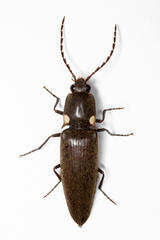 Ignelater havaniensis
583 observations
-
 Melanactes densus
532 observations
-
 Resplendent Click Beetle
Nitidolimonius resplendens
487 observations
-
 Convex Click Beetle
Cardiophorus convexus
80 observations
-
 Melanotus communis
30 observations
-
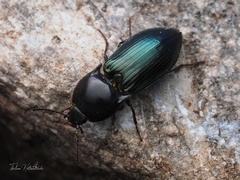 Sapphire-winged Click Beetle
Selatosomus aeripennis
29 observations
-
 Gambrinus pictus
13 observations
-
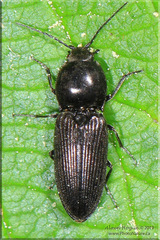 Cardiophorus gagates
12 observations
-
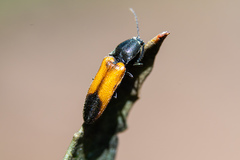 Gambrinus mirus
12 observations
-
 Cardiophorus convexulus
5 observations