family
Hornets, Paper Wasps, Potter Wasps, and Allies
Vespidae
Field notes
The Vespidae are a large (nearly 5000 species), diverse, cosmopolitan family of wasps, including nearly all the eusocial wasps (such as Polistes fuscatus, Vespa orientalis, and Vespula germanica) and many solitary wasps. Each social wasp colony includes a queen and a number of female workers with varying degrees of sterility relative to the queen. In temperate social species, colonies usually last only one year, dying at the onset of winter. New queens and males (drones) are produced towards the end of the summer, and after mating, the queens hibernate over winter in cracks or other sheltered locations. The nests of most species are constructed out of mud, but polistines and vespines use plant fibers, chewed to form a sort of paper (also true of some stenogastrines). Many species are pollen vectors contributing to the pollination of several plants, being potential or even effective pollinators, while others are notable predators of pest insect species, and a few species are invasive pests.
The subfamilies Polistinae and Vespinae are composed solely of eusocial species, while the Eumeninae, Euparagiinae, Gayellinae, Masarinae and Zethinae are all solitary with the exception of a few communal and several subsocial species. The Stenogastrinae are facultatively eusocial, considering nests may have one or several adult females; in cases where the nest is shared by multiple females (typically, a mother and her daughters) there is reproductive division of labor and cooperative brood care.
In the Polistinae and Vespinae, rather than consuming prey directly, prey are premasticated and fed to the larvae, which in return, produce a clear liquid (with high amino acid content) for the adults to consume; the exact amino acid composition varies considerably among species, but it is considered to contribute substantially to adult nutrition.
Fossils are known since Aptian of the Early Cretaceous, with several described species from Cretaceous amber.
Read more on WikipediaChildren
Range
Greener is more native, amber more introduced; paler is less certain. How this was decided
Most observed native hornets, paper wasps, potter wasps, and allies All
Native to the US, by observations.
-
 Northern Paper Wasp
Polistes fuscatus
73,956 observations
-
 Bald-faced Hornet
Dolichovespula maculata
65,651 observations
-
 Eastern Yellowjacket
Vespula maculifrons
40,941 observations
-
 Guinea Paper Wasp
Polistes exclamans
36,169 observations
-
 Metric Paper Wasp
Polistes metricus
34,810 observations
-
 Fraternal Potter Wasp
Eumenes fraternus
22,435 observations
-
 Western Yellowjacket
Vespula pensylvanica
20,700 observations
-
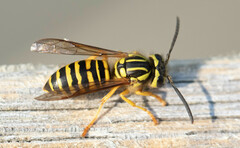 Southern Yellowjacket
Vespula squamosa
19,319 observations
-
 Common Aerial Yellowjacket
Dolichovespula arenaria
18,759 observations
-
 Hunter's Little Paper Wasp
Polistes dorsalis
13,995 observations
-
 Golden Paper Wasp
Polistes aurifer
9,199 observations
-
 American Yellowjacket
Vespula alascensis
7,079 observations
-
 Apache Paper Wasp
Polistes apachus
6,457 observations
-
 Red-marked Pachodynerus Wasp
Pachodynerus erynnis
5,467 observations
-
 Mexican Paper Wasp
Mischocyttarus mexicanus
3,499 observations