family
Mosquitoes
Culicidae
Field notes
Mosquitoes, the Culicidae, are a family of small flies consisting of 3,600 species. The word mosquito (formed by mosca and diminutive -ito) is Spanish and Portuguese for little fly. Mosquitoes have a slender, segmented body, one pair of wings, three pairs of long hair-like legs, and a specialized, highly elongated set of mouthparts forming a proboscis, adapted for piercing and sucking. All mosquitoes drink nectar from flowers; females of many species have adapted to also drink blood. The group diversified during the Cretaceous period. Evolutionary biologists view mosquitoes as micropredators, small animals that parasitise larger ones by drinking their blood without immediately killing them. Medical parasitologists view mosquitoes as vectors of disease, carrying protozoan parasites or bacterial or viral pathogens from one host to another.
The mosquito lifecycle consists of four stages: egg, larva, pupa, and adult. Eggs are laid on the water surface; they hatch into motile larvae that feed on aquatic algae and organic material. These larvae are important food sources for many freshwater animals, such as dragonfly nymphs, many fish, and some birds. Adult females of many species have mouthparts adapted to pierce the skin of a host and feed on blood of a wide range of vertebrate hosts, and some invertebrates, primarily other arthropods. Some species only produce eggs after a blood meal.
The mosquito's saliva is transferred to the host during the bite, and can cause an itchy rash. In addition, blood-feeding species can ingest pathogens while biting and transmit them to other hosts. Those species include vectors of parasitic diseases such as malaria and filariasis, and arboviral diseases such as yellow fever and dengue fever. By transmitting diseases, mosquitoes cause the deaths of over one million people each year.
Read more on WikipediaChildren
Range
Greener is more native, amber more introduced; paler is less certain. How this was decided
Most observed native mosquitoes All
Native to the US, by observations.
-
 Inland Floodwater Mosquito
Aedes vexans
6,751 observations
-
 Common House Mosquito
Culex pipiens
6,447 observations
-
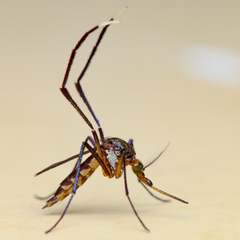 White-footed Woods Mosquito
Psorophora ferox
2,550 observations
-
 Eastern Treehole Mosquito
Aedes triseriatus
1,467 observations
-
 Western Encephalitis Mosquito
Culex tarsalis
1,253 observations
-
 Cold Weather Mosquito
Culiseta incidens
1,245 observations
-
 White-dotted Mosquito
Culex restuans
726 observations
-
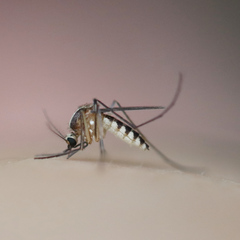 Aedes atlanticus
240 observations
-
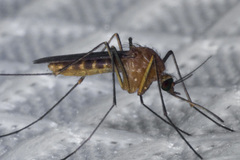 Tule Mosquito
Culex erythrothorax
39 observations
-
 Anopheles crucians
23 observations