superfamily
Typical Crane Flies
Tipuloidea
Field notes
A crane fly or crane-fly, the larva called a leatherjacket, is a member of the dipteran superfamily Tipuloidea, which contains the living families Cylindrotomidae, Limoniidae, Pediciidae and Tipulidae, as well as several extinct families. "Winter crane flies", members of the family Trichoceridae, are sufficiently different from the typical crane flies of Tipuloidea to be excluded from the superfamily Tipuloidea, and are placed as their sister group within Tipulomorpha. Two other families of flies, the phantom crane flies (Ptychopteridae) and primitive crane flies (Tanyderidae), have similar common names due to their similar appearance.
The classification of crane flies has been varied in the past, with some or all of these families treated as subfamilies, but the following classification is currently accepted. Species counts are approximate, and vary over time.
Superfamily Tipuloidea (typical crane flies)
Family Cylindrotomidae (Cylindrotomid or long-bodied crane flies, 67 species)
Family Limoniidae (Limoniid crane flies, 10,786 species, possibly paraphyletic)
Family Pediciidae (Hairy-eyed crane flies, 498 species)
Family Tipulidae (Large crane flies, 4,351 species)
In colloquial speech, crane flies are also sometimes called "daddy longlegs", a name which is also used for arachnids of the family Pholcidae and the order Opiliones. The larvae of crane flies are known as leatherjackets.
Crane flies first appeared during the Middle Triassic, around 245 million years ago, making them one of the oldest known groups of flies, and are found worldwide, though individual species usually have limited ranges. They are most diverse in the tropics but are also common in northern latitudes and high elevations.
More than 15,500 species and over 500 genera of crane flies have been described, the majority by C.P. Alexander, who published descriptions of 10,890 new species and subspecies, and 256 new genera and subgenera over a period of 71 years from 1910–1981.
Read more on WikipediaChildren
Range
Greener is more native, amber more introduced; paler is less certain. How this was decided
Most observed native typical crane flies All
Native to the US, by observations.
-
 Sixspot Cranefly
Limonia nubeculosa
4,563 observations
-
 Giant Western Crane Fly
Holorusia hespera
3,036 observations
-
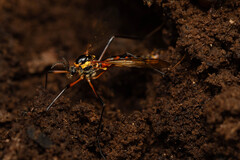 Tiger Cranefly
Phoroctenia vittata
648 observations
-
 Antocha monticola
62 observations
-
 Libnotes perkinsi
18 observations
-
 Dicranomyia hawaiiensis
8 observations
-
 Geranomyia advena
7 observations
-
 Dicranomyia swezeyi
7 observations
-
 Dicranomyia stygipennis
3 observations