superfamily
Hairy and Typical Cicadas
Cicadoidea
Field notes
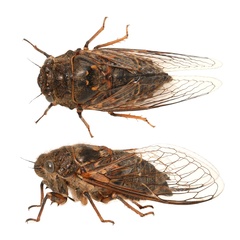
The cicadas () are a superfamily, the Cicadoidea, of insects in the order Hemiptera (true bugs). They are in the suborder Auchenorrhyncha, along with smaller jumping bugs such as leafhoppers and froghoppers. The superfamily is divided into two families, the Tettigarctidae, with two species in Australia, and the Cicadidae, with more than 3,000 species described from around the world; many species remain undescribed. Nearly all cicada species are annual cicadas with the exception of the few North American periodical cicada species, genus Magicicada, which in a given region emerge en masse every 13 or 17 years.
Cicadas have prominent eyes set wide apart, short antennae, and membranous front wings. They have an exceptionally loud song, produced in most species by the rapid buckling and unbuckling of drum-like tymbals. The earliest known fossil Cicadomorpha appeared in the Upper Permian period; extant species occur all around the world in temperate to tropical climates. They typically live in trees, feeding on watery sap from xylem tissue, and laying their eggs in a slit in the bark. Most cicadas are cryptic. The vast majority of species are active during the day as adults, with some calling at dawn or dusk. Only a rare few species are known to be nocturnal.
One exclusively North American genus, Magicicada (the periodical cicadas), which spend most of their lives as underground nymphs, emerge in predictable intervals of 13 or 17 years, depending on the species and the location. The unusual timing and synchronization of their emergence may reduce cicada losses to predation by making them less reliable prey and by overwhelming predators with sheer numbers before significant losses occur.
The annual cicadas are species that emerge every year. Though these cicadas' life cycles can vary from one to nine or more years as underground nymphs, their emergence above ground as adults is not synchronized, so some members of each species appear every year.
Cicadas have been featured in literature since the time of Homer's Iliad and as motifs in art from the Chinese Shang dynasty. They have also been used in myth and folklore as symbols of carefree living and immortality. The cicada is also mentioned in Hesiod's Shield (ll. 393–394), in which it is said to sing when millet first ripens. Cicadas are eaten by humans in various parts of the world, including China, Myanmar, Malaysia, central Africa and parts of Mexico.
Read more on WikipediaChildren
Range
Greener is more native, amber more introduced; paler is less certain. How this was decided
Most observed native hairy and typical cicadas All
Native to the US, by observations.
-
 Swamp Cicada
Neotibicen tibicen
21,395 observations
-
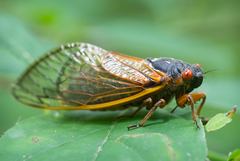 Pharaoh Cicada
Magicicada septendecim
17,410 observations
-
 Scissor Grinder
Neotibicen pruinosus
11,435 observations
-
 Resh Cicada
Megatibicen resh
10,006 observations
-
 Lyric Cicada
Neotibicen lyricen
8,595 observations
-
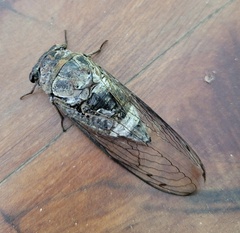 Northern Dusk-singing Cicada
Megatibicen grossus
6,200 observations
-
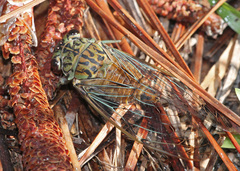 Hieroglyphic Cicada
Neocicada hieroglyphica
4,640 observations
-
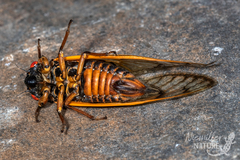 Riley's 13-Year Cicada
Magicicada tredecim
3,661 observations
-
 Cassin's 13-Year Cicada
Magicicada tredecassini
2,772 observations
-
 Davis's Southeastern Dog-day Cicada
Neotibicen davisi
2,328 observations
-
 Putnam's Cicada
Platypedia putnami
1,679 observations
-
 Resonant Cicada
Megatibicen resonans
1,161 observations
-
 Salmonfly Cicada
Platypedia areolata
1,157 observations
-
 Atlantic Saltmarsh Cicada
Diceroprocta viridifascia
1,147 observations
-
 Van Duzee's Cicada
Tibicinoides vanduzeei
819 observations