class
Brittle Stars
Ophiuroidea
Field notes
Brittle stars, serpent stars, or ophiuroids (from Latin ophiurus 'brittle star'; from Ancient Greek ὄφις (óphis) 'serpent' and οὐρά (ourá) 'tail'; referring to the serpent-like arms of the brittle star) are star-shaped echinoderms in the taxonomic class Ophiuroidea.
The Ophiuroidea contain two large clades, Ophiurida (brittle stars) and Euryalida (basket stars). Over 2,000 species of brittle stars spread across 256 recognized genera live today, making the class of Ophiuroidea the most diverse and abundant of all other classes of echinoderms. They are found from the tropics to the poles, from coastal shores to the hadal zone, with more than 1,200 of the species found in depths of greater than 200 m (656 ft). Despite their abundance, brittle stars have not been well-researched like their cousins, the Asteroidea (starfish). They play a vital role in marine ecosystems by enriching the environment.
Brittle stars crawl across the sea floor using their flexible arms for locomotion. They generally have a central disc with five long, slender, whip-like arms which range from mere millimeters to 60 cm (24 in) in length on the largest specimens. They come in a variety of color shades ranging from black, white, red, pink or blue to name a few and some species also have a pattern of two or more colors. Brittle stars can reproduce both sexual and asexually. They have the remarkable ability to regenerate lost or damaged arms and can also automotize their arms as a defense mechanism. They are mostly predators of benthic invertebrates. Fossil records of brittle stars date back to the Early Ordovician period around 480 million years ago, this makes them older than the starfish by at least 30 million years. Unlike starfish, brittle stars are not used as a food source by humans.
Read more on WikipediaChildren
Range
Greener is more native, amber more introduced; paler is less certain. How this was decided
Most observed native brittle stars All
Native to the US, by observations.
-
 Western Spiny Brittle Star
Ophiothrix spiculata
4,457 observations
-
 Dwarf Brittle Star
Amphipholis squamata
3,057 observations
-
 Banded Brittle Star
Ophionereis annulata
3,042 observations
-
 Panama Serpent Star
Ophioderma panamense
1,315 observations
-
 Flat-spined Brittle Star
Ophiopteris papillosa
846 observations
-
 Long-armed Brittle Star
Amphiodia occidentalis
830 observations
-
 Esmark's Brittle Star
Ophioplocus esmarki
773 observations
-
 Little Six-arm Brittle Star
Ophiactis savignyi
558 observations
-
 Ophiocoma erinaceus
302 observations
-
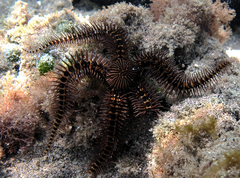 Pied Brittle Star
Breviturma pica
156 observations
-
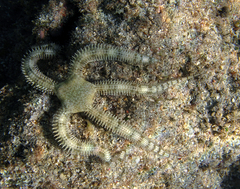 Breviturma brevipes
71 observations
-
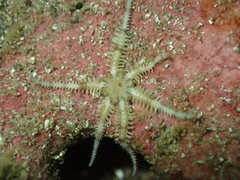 Ophiactis simplex
14 observations
-
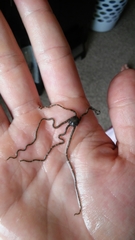 Ophiophragmus filograneus
11 observations