subfamily
Gulls
Larinae
Field notes
Gulls, informally called seagulls (see Taxonomy), are seabirds of the subfamily Larinae. They are most closely related to terns and skimmers, and are placed with them in the family Laridae. They are also related, more distantly, to auks and skuas, and more distantly still to waders. Until the 21st century, most gulls were placed in the genus Larus, but that arrangement is now considered polyphyletic, leading to the readoption and revision of several genera.
An older name for gulls is mew; this still exists in certain regional English dialects and is cognate with German Möwe, Danish måge, Swedish mås, Dutch meeuw, Norwegian måke/måse, and French mouette; both 'gull' and 'mew' are ultimately onomatopoeic in origin, derived from the calls of the birds.
Gulls are usually grey and white, often with black markings on the head or wings, strong bills, and all have webbed feet. They normally have harsh mewing, wailing, or squawking calls. Most gulls are ground-nesting piscivores or carnivores which take live food or scavenge opportunistically, particularly the larger species in the genus Larus. Live food includes crustaceans, molluscs, fish, and for the larger species, birds and mammals. Gulls' jaws can unhinge to allow them to consume large prey. They are typically coastal or inshore (or even inland) species, rarely venturing far out to sea, except the kittiwakes and Sabine's gull. The large species take up to four years to attain full adult plumage, but two years is typical for small gulls. Large white-headed gulls are usually long-lived birds, with a maximum age of 49 years recorded for the European herring gull.
Gulls nest in large, often densely packed, noisy colonies. They lay two or three speckled eggs in nests composed of vegetation. The young are precocial, born with dark mottled down and mobile upon hatching. Gulls are resourceful, inquisitive, and intelligent, the larger species in particular, demonstrating complex methods of communication and a highly developed social structure. For example, many gull colonies display mobbing behaviour, attacking and harassing predators and other intruders. Certain species, such as the herring gull, have exhibited tool-use behaviour, for example using pieces of bread as bait with which to catch goldfish. Many species of gulls have learned to coexist successfully with humans and thrive in human habitats. Others rely on kleptoparasitism to get their food. Gulls have been observed preying on live whales, landing on the whale as it surfaces and pecking out pieces of flesh.
Read more on WikipediaChildren
Range
Greener is more native, amber more introduced; paler is less certain. How this was decided
Most observed native gulls All
Native to the US, by observations.
-
 Black-headed Gull
Chroicocephalus ridibundus
184,517 observations
-
 Ring-billed Gull
Larus delawarensis
171,257 observations
-
 Laughing Gull
Leucophaeus atricilla
100,648 observations
-
 American Herring Gull
Larus smithsonianus
98,160 observations
-
 Western Gull
Larus occidentalis
81,000 observations
-
 Lesser Black-backed Gull
Larus fuscus
66,704 observations
-
 Great Black-backed Gull
Larus marinus
47,507 observations
-
 Common Gull
Larus canus
46,627 observations
-
 California Gull
Larus californicus
38,482 observations
-
 Kelp Gull
Larus dominicanus
38,179 observations
-
 Bonaparte's Gull
Chroicocephalus philadelphia
27,770 observations
-
 Heermann's Gull
Larus heermanni
25,588 observations
-
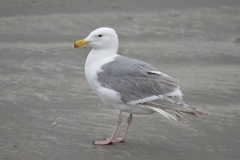 Glaucous-winged Gull
Larus glaucescens
23,329 observations
-
 Black-legged Kittiwake
Rissa tridactyla
17,270 observations
-
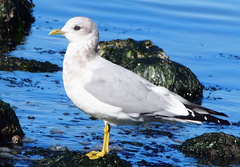 Short-billed Gull
Larus brachyrhynchus
16,245 observations