family
Ocean Dolphins
Delphinidae
Field notes
Oceanic dolphins or Delphinidae are a widely distributed family of dolphins that live in the sea. Close to forty extant species are recognised. They include several big species whose common names contain "whale" rather than "dolphin", such as the Globicephalinae (round-headed whales, which include the false killer whale and pilot whale). Delphinidae is a family within the superfamily Delphinoidea, which also includes the porpoises (Phocoenidae) and the Monodontidae (beluga whale and narwhal). River dolphins are a grouping of at least three cetacean superfamilies which form a sister group to Delphinoidea.
Oceanic dolphins range in size from the 1.7-metre-long (5 ft 7 in) and 50-kilogram (110-pound) Maui's dolphin to the 9.4-metre (31 ft) and 10-metric-ton (11-short-ton) orca, the largest known dolphin. Several species exhibit sexual dimorphism; the males are larger than females. They have streamlined muscular bodies and two limbs that are modified into flippers. Though not quite as flexible as seals, some dolphins can travel at speeds 29 km/h (18 mph) for short distances. Most delphinids primarily eat fish, along with a smaller number of squid and small crustaceans, but some species specialise in eating squid, or, in the case of the orca, also eat marine mammals and birds. All, however, are purely carnivorous. They typically have between 100 and 200 teeth, although a few species have considerably fewer. Delphinids travel in large pods, which may number a thousand individuals in some species. Each pod forages over a range of tens to hundreds of square kilometres. Some pods have a loose social structure, with individuals frequently joining or leaving, but others seem to be more permanent, perhaps dominated by a male and a harem of females. Individuals communicate by sound, producing low-frequency whistles, and also produce high-frequency broadband clicks of 80–220 kHz, which are primarily used for echolocation. Gestation lasts from 10 to 18 months, and results in the birth of a single calf. Some species are well adapted for diving to great depths. They have a layer of fat, or blubber, under the skin to keep warm in the cold water.
Although oceanic dolphins are widespread, most species prefer the warmer waters of the tropic zones, but some, like the right whale dolphin, prefer colder climates. Some have a global distribution, like the orca. Oceanic dolphins feed largely on fish and squid, but a few, like the orca, feed on large mammals, like seals. Male dolphins typically mate with multiple females every year, but females only mate every two to three years. Calves are typically born in the spring and summer, and females bear all the responsibility for raising them. Mothers of some species fast and nurse their young for relatively long times. Dolphins produce a variety of vocalizations, usually in the form of clicks and whistles.
Oceanic dolphins are sometimes hunted in places such as Japan and the Faroe Islands in an activity known as dolphin drive hunting. Besides drive hunting, they also face threats from bycatch, habitat loss, and marine pollution. Dolphins have been depicted in various cultures worldwide. They occasionally feature in literature and film, as in the Warner Bros film Free Willy. Dolphins are sometimes kept in captivity and trained to perform in shows. The most common species of dolphin in captivity is the bottlenose dolphin, and less than 50 orca were found in oceanariums in 2012.
Read more on WikipediaChildren
Range
Greener is more native, amber more introduced; paler is less certain. How this was decided
Most observed native ocean dolphins All
Native to the US, by observations.
-
 Common Bottlenose Dolphin
Tursiops truncatus
25,502 observations
-
 Common Dolphin
Delphinus delphis
12,238 observations
-
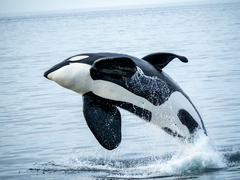 Orca
Orcinus orca
11,146 observations
-
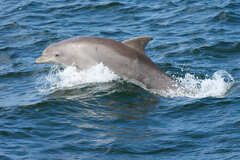 Tamanend's Bottlenose Dolphin
Tursiops erebennus
4,227 observations
-
 Spinner Dolphin
Stenella longirostris
3,338 observations
-
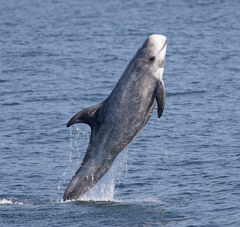 Risso's Dolphin
Grampus griseus
3,285 observations
-
 Atlantic Spotted Dolphin
Stenella frontalis
2,221 observations
-
 Pantropical Spotted Dolphin
Stenella attenuata
1,841 observations
-
 Pacific White-sided Dolphin
Aethalodelphis obliquidens
1,638 observations
-
 Long-finned Pilot Whale
Globicephala melas
1,246 observations
-
 Atlantic White-sided Dolphin
Leucopleurus acutus
760 observations
-
 White-beaked Dolphin
Lagenorhynchus albirostris
759 observations
-
 False Killer Whale
Pseudorca crassidens
464 observations
-
 Northern Right Whale Dolphin
Lissodelphis borealis
347 observations
-
 Rough-toothed Dolphin
Steno bredanensis
308 observations