genus
Shanks, Tattlers, and Allies
Tringa
Field notes
Tringa is a genus of waders, containing the shanks and tattlers. The genus name Tringa is the Neo-Latin name given to the green sandpiper by the Italian naturalist Ulisse Aldrovandi in 1599. They are mainly freshwater birds, often with brightly coloured legs as reflected in the English names of six species, as well as the specific names of two of these and the green sandpiper. They are typically associated with northern hemisphere temperate regions for breeding. Some of this group—notably the green sandpiper and the solitary sandpiper—nest in trees, using the old nests of other birds, usually thrushes.
The willet and the tattlers have been found to belong in Tringa; these genus changes were formally adopted by the American Ornithologists' Union in 2006.
The present genus in the old, more limited sense was even further subdivided into Tringa proper and Totanus, either as subgenera or as full genera. The available DNA sequence data suggests however that neither of these is monophyletic and that the latter simply lumps together a number of more or less closely related apomorphic species. Totanus is not therefore now accepted even as a subgenus.
Read more on WikipediaChildren
Range
Greener is more native, amber more introduced; paler is less certain. How this was decided
Most observed native shanks, tattlers, and allies All
Native to the US, by observations.
-
 Willet
Tringa semipalmata
80,971 observations
-
 Greater Yellowlegs
Tringa melanoleuca
74,746 observations
-
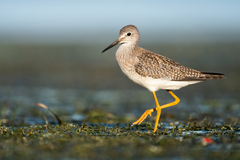 Lesser Yellowlegs
Tringa flavipes
39,069 observations
-
 Solitary Sandpiper
Tringa solitaria
34,021 observations
-
 Spotted Redshank
Tringa erythropus
10,312 observations
-
 Wandering Tattler
Tringa incana
5,783 observations