subfamily
Formicine Ants
Formicinae
Field notes
The Formicinae are a subfamily within the Formicidae family containing ants of moderate evolutionary development.
Formicines retain some primitive features, such as the presence of cocoons around pupae, the presence of ocelli in workers, and little tendency toward reduction of palp or antennal segmentation in most species, except subterranean groups. Extreme modification of mandibles is rare, except in the genera Myrmoteras and Polyergus. However, some members show considerable evolutionary advancement in behaviors such as slave-making and symbiosis with root-feeding hemipterans. Finally, all formicines have very reduced stings and enlarged venom reservoirs, with the venom gland, specialized (uniquely among ants) for the production of formic acid.
All members of the Formicinae "have a one-segmented petiole in the form of a vertical scale".
Read more on WikipediaChildren
Range
Greener is more native, amber more introduced; paler is less certain. How this was decided
Most observed native formicine ants All
Native to the US, by observations.
-
 Eastern Black Carpenter Ant
Camponotus pennsylvanicus
61,776 observations
-
 American Winter Ant
Prenolepis imparis
26,594 observations
-
 Chestnut Carpenter Ant
Camponotus castaneus
18,049 observations
-
 Ferruginous Carpenter Ant
Camponotus chromaiodes
13,215 observations
-
 Silky Field Ant
Formica subsericea
9,214 observations
-
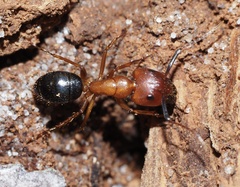 Florida Carpenter Ant
Camponotus floridanus
8,825 observations
-
 Western Black Carpenter Ant
Camponotus modoc
8,301 observations
-
 Western Thatching Ant
Formica obscuripes
7,684 observations
-
 Turfgrass Ant
Lasius neoniger
6,902 observations
-
 Hercules Carpenter Ant
Camponotus herculeanus
6,583 observations
-
 American Carpenter Ant
Camponotus americanus
6,561 observations
-
 New York Carpenter Ant
Camponotus novaeboracensis
6,348 observations
-
 Nearctic Carpenter Ant
Camponotus nearcticus
5,128 observations
-
 Bearded Carpenter Ant
Camponotus subbarbatus
4,699 observations
-
 Common Citronella Ant
Lasius claviger
4,347 observations