subfamily
Panurgine Bees
Panurginae
Field notes
The bee subfamily Panurginae is a diverse lineage of 33 genera in 7 tribes. They are particularly diverse in the New World, though scarce in the tropics, and in the Old World they can be found primarily in the Palaearctic and Africa, but absent from Australia and tropical Asia. They tend to be associated with xeric or sandy habitats.
The "facial foveae" of Panurgines are not broad, velvety depressions as in Andreninae, but reduced to grooves or pits at the upper margin of the eyes. The apex of the marginal cell of the wing is truncate, and the trochanteral scopa is reduced. Panurgines also frequently have yellow markings in locations other than on the face, a feature not seen in any other subfamilies of Andrenidae.
Most members of this subfamily are oligolectic, with highly specialized floral associations, especially in desert species.
Read more on WikipediaChildren
Range
Greener is more native, amber more introduced; paler is less certain. How this was decided
Most observed native panurgine bees All
Native to the US, by observations.
-
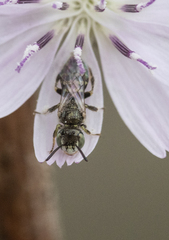 Perdita hirticeps
948 observations
-
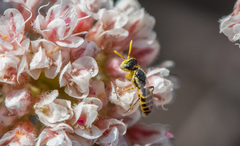 Rhus Fairy Bee
Perdita rhois
656 observations
-
 California Fairy Bee
Perdita californica
541 observations
-
 Calliopsis rhodophila
394 observations
-
 Calliopsis subalpina
359 observations
-
 California Poppy Fairy Bee
Perdita interrupta
334 observations
-
 Eight-spotted Fairy Bee
Perdita octomaculata
294 observations
-
 Eastern Bare-Miner
Protandrena andrenoides
218 observations
-
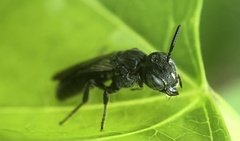 Passionflower Bee
Protandrena passiflorae
213 observations
-
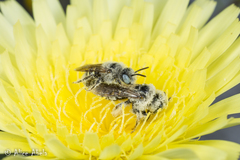 Desert-dandelion Nomadopsis
Calliopsis puellae
182 observations
-
 All-pale Perdita
Perdita perpallida
147 observations
-
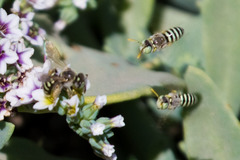 Calliopsis hesperia
136 observations
-
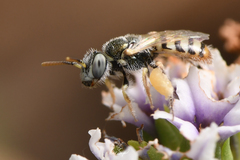 Heliotrope Fairy Bee
Perdita heliotropii
135 observations
-
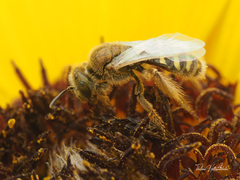 White-winged Fairy Bee
Perdita albipennis
97 observations
-
 Protandrena aethiops
94 observations