subfamily
Apine Bees
Apinae
Field notes
The Apinae are the subfamily that includes the majority of bees in the family Apidae. It includes the familiar "corbiculate" (pollen basket) bees—bumblebees, honey bees, orchid bees, stingless bees, and the extinct genus Euglossopteryx. It also includes all but two of the groups (excluding Nomadinae and Xylocopinae) that were previously classified in the family Anthophoridae.
Most species in the subfamily (other than honey bees, bumblebees, and stingless bees) are solitary, though several of the tribes are entirely kleptoparasitic, such as the Ericrocidini, Isepeolini, Melectini, Osirini, Protepeolini, and Rhathymini.
Read more on WikipediaChildren
Range
Greener is more native, amber more introduced; paler is less certain. How this was decided
Most observed native apine bees All
Native to the US, by observations.
-
 Common Eastern Bumble Bee
Bombus impatiens
314,135 observations
-
 Brown-belted Bumble Bee
Bombus griseocollis
128,670 observations
-
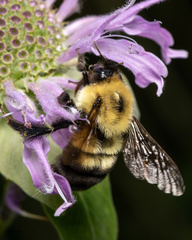 Two-spotted Bumble Bee
Bombus bimaculatus
81,210 observations
-
 American Bumble Bee
Bombus pensylvanicus
68,102 observations
-
 Yellow-faced Bumble Bee
Bombus vosnesenskii
56,866 observations
-
 Tricolored Bumble Bee
Bombus ternarius
37,819 observations
-
 Black-tailed Bumble Bee
Bombus melanopygus
28,643 observations
-
 Red-belted Bumble Bee
Bombus rufocinctus
25,410 observations
-
 Two-spotted Longhorn Bee
Melissodes bimaculatus
21,925 observations
-
 Hunt's Bumble Bee
Bombus huntii
21,057 observations
-
 Perplexing Bumble Bee
Bombus perplexus
17,657 observations
-
 Golden Northern Bumble Bee
Bombus fervidus
16,208 observations
-
 Black-and-gold Bumble Bee
Bombus auricomus
15,542 observations
-
 Half-black Bumble Bee
Bombus vagans
15,226 observations
-
 Fuzzy-Horned Bumble Bee
Bombus mixtus
14,598 observations