subfamily
Voles, Lemmings, and Muskrats
Arvicolinae
Field notes
The Arvicolinae are a subfamily of rodents that includes the voles, lemmings, and muskrats. They are most closely related to the other subfamilies in the Cricetidae (comprising the hamsters and New World rats and mice). Some authorities place the subfamily Arvicolinae in the family Muridae along with all other members of the superfamily Muroidea. Some refer to the subfamily as the Microtinae (yielding the adjective "microtine") or rank the taxon as a full family, the Arvicolidae.
The Arvicolinae are the most populous group of Rodentia in the Northern Hemisphere. They often are found in fossil occlusions of bones cached by past predators such as owls and other birds of prey. Fossils of this group are often used for biostratigraphic dating of paleontological and archeological sites in North America and Europe.
Read more on WikipediaChildren
Range
Greener is more native, amber more introduced; paler is less certain. How this was decided
Most observed native voles, lemmings, and muskrats All
Native to the US, by observations.
-
 Muskrat
Ondatra zibethicus
58,810 observations
-
 Eastern Meadow Vole
Microtus pennsylvanicus
7,055 observations
-
 California Vole
Microtus californicus
3,105 observations
-
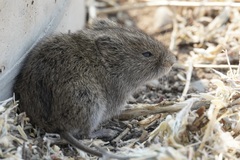 Western Meadow Vole
Microtus drummondii
2,940 observations
-
 Southern Red-backed Vole
Clethrionomys gapperi
1,376 observations
-
 Woodland Vole
Microtus pinetorum
916 observations
-
 Townsend's Vole
Microtus townsendii
799 observations
-
 Northern Red-backed Vole
Clethrionomys rutilus
575 observations
-
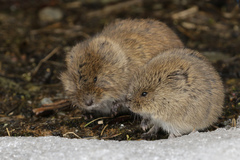 Tundra Vole
Alexandromys oeconomus
310 observations
-
 Montane Vole
Microtus montanus
201 observations
-
 Prairie Vole
Microtus ochrogaster
197 observations
-
 Nearctic Brown Lemming
Lemmus trimucronatus
181 observations
-
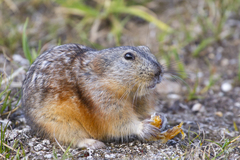 Northern Collared Lemming
Dicrostonyx groenlandicus
162 observations
-
 Long-tailed Vole
Microtus longicaudus
88 observations
-
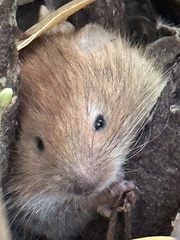 Sonoma Tree Vole
Arborimus pomo
85 observations