species 14 observations
Alexander's Rock Aster
Eurybia avita
Field notes
Eurybia avita, commonly called Alexander's rock aster, is a rare North American plant species, a herbaceous perennial in the family Asteraceae that was formerly considered part of the genus Aster. It is native to the southeastern United States. It is of conservation concern as it is found in less than 50 sites, typically only in sandy soils near granite flatrocks, and it is most likely already extirpated in North Carolina. Its habitat is threatened by development and the recreational use of the area where it grows. It is very similar to both E. surculosa and E. paludosa and more research needs to be done to determine the exact relationship between the three species.
Eurybia avita is a perennial herb sometimes as much as 80 cm (32 inches) tall, having 1-5 stems and reproducing by means of underground rhizomes. The flowers emerge in the late summer to early fall, the plant producing 3-15 or more flower heads in a flat-topped array. Each head contains 8–20 pale blue, purple, or violet ray florets and 15–45 yellow disc florets.
Read more on WikipediaSupports All
supported in the US
-
Specialist bees
Bees whose young are raised on the pollen of it


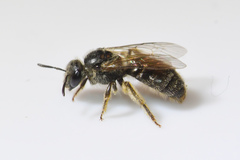 Drury's Long-horned Bee, Aster Mining Bee, Two-celled Sweat Bee
3
-
Hosted animals
Gall makers, leaf miners and other animals living on or in it
 Liriomyza limopsis
1
-
Flower visitors
Pollinators and other flower visitors


 Common Eastern Bumble Bee, Black-shouldered Drone Fly, Northern Paper Wasp, Pure Green Sweat Bee
16
Range
Greener is more native, amber more introduced; paler is less certain. How this was decided
Key traits
- Layer
- Herbaceous plants
- Plant type
- Perennial Wildflower
From USDA PLANTS.