subclass
Barnacles and Allies
Thecostraca
Field notes
Thecostraca (from Ancient Greek θήκη (thḗkē) 'box' and ὄστρακον (óstrakon) 'shell') is a class of marine invertebrates containing over 2,200 described species. Many species have planktonic larvae which become sessile or parasitic as adults.
The most prevalent subgroup are the barnacles (subclass Cirripedia), constituting a little over 2,100 known species.
The subgroup Facetotecta contains a single genus, Hansenocaris, known only from the tiny planktonic nauplii called "y-larvae". These larvae have no known adult form, though it is suspected that they are parasites, and their affinity is uncertain. Some researchers believe that they may be larval tantulocaridans. No larval tantulocaridans are currently known.
The group Ascothoracida contains about 110 species, all parasites of coelenterates and echinoderms.
The nauplius larvae (sometimes absent) can be both lecithotrophic (non-feeding) and planktotrophic (feeding), and is followed by a larval stage called the cyprid, which is always lecithotrophic. The cypridoid larvae are referred to as the y-cyprid in the Facetotecta, the a-cyprid in the Ascothoracida, and the c-cyprid, or just cyprid, in the Cirripedia.
Read more on WikipediaChildren
Range
Greener is more native, amber more introduced; paler is less certain. How this was decided
Most observed native barnacles and allies All
Native to the US, by observations.
-
 Gooseneck Barnacle
Pollicipes polymerus
18,092 observations
-
 Pacific Acorn Barnacle
Balanus glandula
12,679 observations
-
 Pink Volcano Barnacle
Tetraclita rubescens
6,206 observations
-
 Pelagic Gooseneck Barnacle
Lepas anatifera
3,558 observations
-
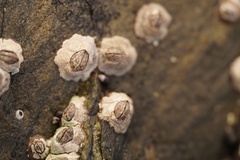 Little Brown Barnacle
Chthamalus dalli
2,670 observations
-
 Chthamalus fissus
249 observations
-
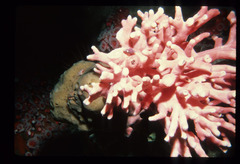 Armatobalanus nefrens
2 observations