order
Terebratulid Brachiopods
Terebratulida
Field notes
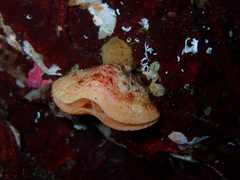
Terebratulids are one of only three living orders of articulate brachiopods, the others being the Rhynchonellida and the Thecideida. Craniida and Lingulida include living brachiopods, but are inarticulates. The name, Terebratula, may be derived from the Latin "terebra", meaning "hole-borer". The perceived resemblance of terebratulid shells to ancient Roman oil lamps gave the brachiopods their common name "lamp shell".
Terebratulids typically have biconvex shells that are usually ovoid to circular in outline. They can be either smooth or have radial ribbing. The lophophore support is loop shaped in contrast to the spiralia of similar looking spiriferids. Terebratulids are also distinguished by a very short hinge line, and the shell is punctate in microstructure. There is a circular pedicle opening, or foramen, located in the beak.
Terebratulids may have evolved from Atrypids during the early or Middle Silurian. Early genera were almost circular to elongate-oval, with smooth or finely costate shells. During the Cretaceous and Tertiary periods, many shells became coarsely plicate.
Read more on WikipediaChildren
Range
Greener is more native, amber more introduced; paler is less certain. How this was decided
Most observed native terebratulid brachiopods All
Native to the US, by observations.