species 24,016 observations
Broad-leaved Goldenrod
Solidago flexicaulis
Field notes
Solidago flexicaulis, the broadleaved goldenrod, or zigzag goldenrod, is a North American species of herbaceous perennial plants in the family Asteraceae. It is native to the eastern and central parts of the United States and Canada, from Nova Scotia west to Ontario and the Dakotas, and south as far as Alabama and Louisiana. It grows in a variety of habitats including mesic upland forests, well drained floodplain forests, seepage swamp hummocks, and rocky woodlands.
The plant is called the "zigzag goldenrod" because the thin, wiry stem zigs and zags back and forth, changing direction at each node (leaf attachment point). The plant bears sometimes as many as 250 small yellow flower heads, some at the end of the stem, others in the axils of the leaves. The leaves are very broad, almost round, but with an elongated tip at the end and large teeth along the edges.
Solidago flexicaulis shares some similarities to Solidago albopilosa, both molecularly and physically. There is some evidence indicating that the plant is an ancient autopolyploid of S. flexicaulis.
Read more on WikipediaSupports All
supported in the US
-
Caterpillars
Moths and butterflies raised on it
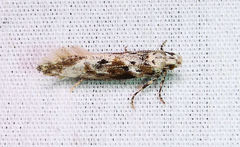
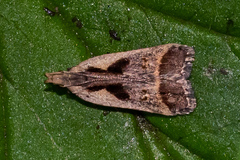

 Gnorimoschema gallaeasterella, Bilobed Dichomeris Moth, Brown-hooded Owlet, Wavy-lined Emerald
96
-
Specialist bees
Bees whose young are raised on the pollen of it


 Carpenter-mimic Leafcutter Bee, Dark-veined Longhorn Bee, Drury's Long-horned Bee, Hairy-banded Mining Bee
30
-
Hosted animals
Gall makers, leaf miners and other animals living on or in it


 Ophiomyia maura, Asteromyia modesta, Goldenrod Gall Fly, Carbonifera Goldenrod Gall Midge
21
-
Plant eaters
Animals that feed on it


 American Tree Sparrow, Common Aerial Yellowjacket, Bramble Mason Wasp, Western Encephalitis Mosquito
51
-
Flower visitors
Pollinators and other flower visitors


 Common Eastern Bumble Bee, Tricolored Bumble Bee, Eastern Yellowjacket, Northern Paper Wasp
501
-
Sheltered animals
Animals that nest or roost in it


 Eurytoma gigantea, Eurytoma obtusiventris, Galeopsomyia haemon
3
Range
Greener is more native, amber more introduced; paler is less certain. How this was decided
Key traits
- Layer
- Herbaceous plants
- Light
- Full sun Part shade Full shade
- Moisture
- Moist
- Water use
- Medium
- Soil pH
- Acid
- Plant type
- Perennial Wildflower
From USDA PLANTS and the Lady Bird Johnson Wildflower Center.