class
Lichinomycetes
Lichinomycetes
Field notes
Lichinales is the sole order of ascomycete fungi in the class Lichinomycetes. It contains three families: Gloeoheppiaceae (3 genera), Lichinaceae (43 genera), and Peltulaceae (1 genus). Most species are lichenized. Lichinales was proposed in 1986 by German lichenologists Aino Henssen and Burkhard Büdel. The class Lichinomycetes was created by Valérie Reeb, François Lutzoni and Claude Roux in 2004.
A study published in late 2022 suggests that six classes of fungi, Candelariomycetes, Coniocybomycetes, Geoglossomycetes, Lichinomycetes, Sareomycetes, and Xylonomycetes, are all part of a clade that has a sister relationship with a clade containing Lecanoromycetes and Eurotiomycetes. Lichinomycetes is the oldest name among these orders, and so the authors used this name for the group. Phylogenomic analysis of a 481-genome set showed that as a group, the Lichinomycetes have relatively small genomes, and fewer metabolic gene clusters; one consequence of this is an inability to break down cellulose and pectin. Because of this reduced metabolic capability, Lichinomycetes fungi may have adapted to partner symbiotically with other species to compensate for these losses.
The genus Trizodia is currently included in Lichinomycetes based on multi-locus analyses that sampled the Japanese species T. silvestris; these data place the genus in the class but leave its order open (sometimes near Vezdaea). A genome-scale phylogenomic study of 1,292 single-copy genes likewise recovered an expanded Lichinomycetes that includes a Trizodia lineage, supporting its class-level placement even though the ordinal rank remains incertae sedis. Earlier multilocus work offered alternative placements with limited support (e.g., near Candelariomycetes), so recent treatments retain Trizodia in Lichinomycetes pending denser sampling.
Read more on WikipediaChildren
Range
Greener is more native, amber more introduced; paler is less certain. How this was decided
Most observed native Lichinomycetes All
Native to the US, by observations.
-
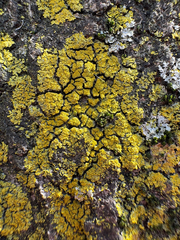 Candleflame Lichen
Candelaria concolor
22,917 observations
-
 Common Goldspeck
Candelariella vitellina
8,435 observations
-
 Hidden Goldspeck Lichen
Candelariella aurella
4,388 observations
-
 Powdery Goldspeck
Candelariella efflorescens
4,284 observations
-
 Sagebrush Goldspeck Lichen
Candelariella rosulans
3,210 observations
-
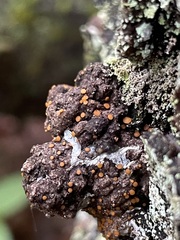 Resin Sarea Lichen
Zythia resinae
1,625 observations
-
 Fringed Candleflame Lichen
Candelaria fibrosa
1,089 observations
-
 Powdery Rock-olive Lichen
Peltula euploca
355 observations
-
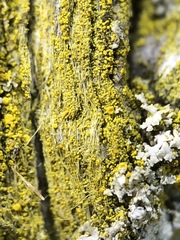 Granular Goldspeck Lichen
Candelariella xanthostigma
297 observations
-
 Confused Limestone Lichen
Thyrea confusa
177 observations
-
 Brown-head Stubble Lichen
Chaenotheca brunneola
158 observations
-
 Waterside Rockshag Lichen
Ephebe lanata
88 observations
-
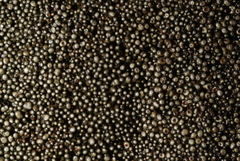 Cylindrical Rock-olive
Peltula cylindrica
76 observations
-
 Southern Powdery Goldspeck
Candelariella xanthostigmoides
43 observations
-
 Common Soil Ruby Lichen
Heppia conchiloba
20 observations